

March 18: Global Recycling Day
A Circular Economy
In Greek mythology, magical objects effortlessly pass from one story to another, from one generation to the next. Harmonia’s necklace is the most obvious example, bringing doom for Dionysos as well as Oidipous, and still as ominous in the Roman era. Other objects that connect multiple myths? For instance the ball that little Zeus played with, passed on to his grandson Eros. Herakles’ bow, that had to be retrieved to end the Trojan war. The leftovers of Prometheus’ experiments to create mankind, still lying around smelling of human flesh. Prometheus’ blood, used by the witch Medeia. The Cretan bull, father of the Minotaure, igniting the Cretan-Athenian war. Helios’ legendary vessel that he lent out to Herakles. Aphrodite’s love belt, turning up in the Trojan myths. The flute, created by Athena, that lead to Marsyas’ feud with Apollo. And the golden fleece of Poseidon’s ram-son that motivated the Argonaut expedition. Some millennia before it became fashionable, the Greeks adopted the circular economy.
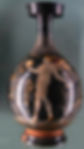
Eros with ball, Lekythos, National Museum Warsaw, Poland

Prometheus Creating Man, Fresco, Museo della Via Ostiense, Roma, Italy