

July 15: Travel Month
Lesbos
When the mythical bard Orpheus lost his wife, he was heartbroken. Never would he sing again, and never would he fall in love again. His miserable appearance was enough to spoil any party, and before long, the god of joy, Dionysos, had enough of it. As had his retinue, his group of “loose women” or “maenads”. “Sure, Eurydike had been beautiful and sweet, but let’s face it, kind of silly too, right? As for her departing, he had only himself to blame. So man up, don’t give up on music, or love! Take a chance on us, if we’re good enough for a god, surely we’re good enough for you!” But Orpheus bluntly told them that none of them compared with his sweet Eurydike, and that Dionysos must be continuously drunk to put up with them. Oh, the hubris… Enraged with indignation, the maenads literally tore him to pieces and threw his remains in the ocean. While his lyre ended up in the sky, as the constellation Lyra, his head would wash up at the shores of Lesbos. It has been an artist’s island ever since, with Sapho as a shining example.
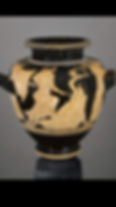
The Death of Orpheus, stamnos, Musée du Louvre, Paris, France
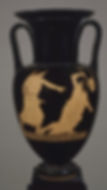
The Death of Orpheus, amphora, Musée du Louvre, Paris, France
Did you know?
Orpheus would have been so talented he could move rocks and trees to tears.
Orpheus would be the son of Apollo and the Muse Kalliope.
Dionysos’ retinue was called “thiasus” and consisted of satyrs and maenads. (Maenad literally translates to “mad woman”, cfr. “Stimuli” and “Cheers!”.)
About Eurydike’s tragic fate: cfr. “Ghost from the Past”.