

Women, Weird and Wonderful: Melissa, Queen Bee
Sticky
The story of Zeus and the bee is not a myth as such, but one of Aesop’s fables
(6th century BC). As “meli” is Greek for honey, Aesop calls his bee Melissa, after a nymph that fostered little baby Zeus. Bee Melissa had produced a jar of honey for the gods to taste, with a special request in mind. In a recent adaptation, the substance “tasted gloopy without being unguent, slow-moving without being stodgy, sweet without being cloying and perfumed with a flavour that drove the senses wild.” So, according to custom, Zeus granted her a wish. Yet, when she started ranting about how much work it took to produce honey all by herself, only to have it stolen time and time again, and how she needed a deadly weapon to protect her delicious creation, he got angry. In the original version, he provides her with a deadly sting, but adds that she can only use it at the cost of her life. In the modern version, he also grants her a hive of worker bees to set up a production line. Which makes this a tale like honey: delicate, but sticky.

Male figures stung by bees, Amphora, British Museum, London, UK
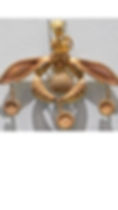
Malia Pendant, Archaeological Museum of Heraklion, Crete, Greece
Did you know...
The Romans did like their bees: "What men... can we set alongside these insects which are superior to men when it comes to reasoning? For they recognise only what is in the common interest..." (Pliny the Elder)
Bees provided signs of future events, mostly bad. But there’s also a story about bees setting on the mouth of Plato as a young child, thus “foretellling the charm of his very pleasing eloquence.” (Pliny the Elder)
The Greek root "meli" (for "honey") is noticeable in the name of the island Malta, where poets travelled to in the hope of creating "honey-sweet" poetry. (cfr. "Honey Sweet" by Missesmyths)